Why a wine cooler at all?
Wine is a living drink. For it to develop well and not spoil before its time, it needs four things: a constant temperature, moderate humidity, darkness and stillness without vibration. In a cellar underground these conditions exist naturally. In an Israeli home, where summer temperatures climb well above 25 degrees, they do not exist without help.
Heat speeds up the aging of wine and flattens the aromas. Sharp swings between day and night make the wine expand and contract, and can push air through the cork. Light, especially UV radiation, harms wine, particularly whites and sparkling wines in clear bottles.
The three types: thermoelectric, compressor and built-in
Thermoelectric wine cooler
A cooler without a compressor. Cooling is done with an electronic component (a Peltier element) that moves heat from inside the cooler to the outside. It has no moving parts apart from a small fan, so it is very quiet and almost free of vibration, a big advantage for the living room, the bedroom or a corner of the kitchen.
The drawback: the cooling capacity is limited, and the cooler only chills a few degrees below room temperature. In an air-conditioned room it works great. On a balcony, in a storeroom or in a hot room in summer it will struggle to reach the desired temperature. That is why thermoelectric coolers usually come in small sizes, up to about 20 bottles.
Compressor wine cooler
Works on the same principle as a regular refrigerator, but is set to the temperature range of wine and keeps it stable. The cooling is strong and stable even when the room is hot, so it is the safe choice for the Israeli climate and for a medium or large collection. In quality models the compressor is insulated and dampens vibration, so the noise is low.
Built-in wine cooler
"Built-in" describes the way it is installed, not the cooling method. In a built-in cooler the ventilation exits through the front, usually through a strip under the door, so it can be installed inside a cabinet, inside a niche or under a kitchen countertop. Most built-in models can also stand freely.
A freestanding cooler vents its heat out the back and sides. It needs ventilation clearance all around, and must never be built into a cabinet. Without ventilation it will overheat, work hard, wear out quickly and chill less well.
| Thermoelectric | Compressor | Built-in | |
|---|---|---|---|
| Noise and vibration | Very quiet, almost no vibration | Quiet, vibration-dampening | Like a compressor cooler |
| Cooling strength | Limited, depends on room heat | Strong and stable | Strong and stable |
| Typical size | Small | From small to very large | From small to large |
| Installation | Freestanding only | Freestanding only | Inside a cabinet, under a countertop or freestanding |
| Suitable for | An air-conditioned room, a small quantity | Any home, a large collection | A designed kitchen, saving space |
One or two cooling zones
One zone: a single temperature throughout the cooler. Suited to long storage, because all wines, red and white, age best at a constant temperature of about 12 to 14 degrees. Before serving, you chill the bottle or take it out for a little while.
Two zones: two compartments with separate temperatures. This way you can keep white wines and sparkling wines ready to serve in a cold compartment, and reds in another. This is especially convenient for anyone who hosts a lot, or who wants to both store and serve from the same cooler.
Temperatures for every type of wine
Temperature changes the taste a great deal. A wine that is too cold sounds "closed" and its aromas are hard to sense. A wine that is too warm sounds alcoholic and heavy. These are the usual serving ranges:
| Wine type | Serving temperature | In the shop |
|---|---|---|
| Sparkling wine and Champagne | 6–8 degrees | Sparkling wines |
| Light, fresh whites, rosé | 8–10 degrees | Whites · Rosé |
| Rich, barrel-aged whites | 10–13 degrees | Whites |
| Light reds | 12–14 degrees | Reds |
| Full, rich reds | 15–18 degrees | Reds |
| Sweet dessert wines | 6–10 degrees | Dessert wines |
| Long storage, all wines | 12–14 degrees, constant | All wines |
Tip: the "room temperature" recommended for reds refers to a cool European room, not an Israeli living room in summer. A red sitting on the countertop at 28 degrees will benefit from 20 minutes in the cooler before serving.
How many bottles do you need?
The accepted rule: count how many bottles you have today, and buy a cooler one and a half to two times as large. Collections tend to grow, and a cooler filled to the brim leaves no room for a special bottle that arrives as a gift or from a winery visit.
- Up to 20 bottles: someone who drinks wine on weekends and at holiday meals and wants a few bottles always ready.
- 20 to 50 bottles: wine lovers who buy cases, and keep a few wines for the years ahead.
- Over 50 bottles: collectors, anyone who ages wines over the years, and restaurants.
Where to place it and how to install it
- Away from heat sources: oven, stovetop, dishwasher, radiator, and a wall that the sun heats.
- Not in direct sunlight, even if the glass is UV-protected.
- On a level, stable surface. Adjust the cooler's feet so that it does not wobble.
- A freestanding cooler: leave ventilation clearance at the back and sides, according to the manufacturer's instructions.
- A built-in cooler: make sure the ventilation opening at the front is not blocked, and that the niche dimensions match the installation instructions.
- A thermoelectric cooler: only in a room where the temperature is moderate, preferably air-conditioned.
- After transport, it is worth letting the cooler stand upright for a few hours before plugging it in, according to the manufacturer's instructions.
What else to check
- A glass door with UV protection: lets you see the bottles without opening, and protects the wine from light.
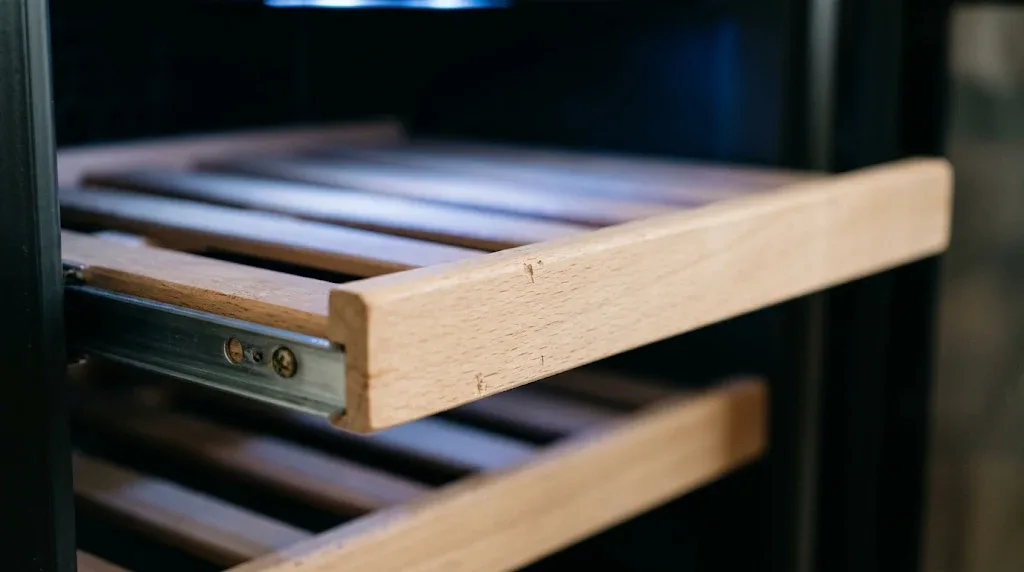
- Wooden or metal shelves: wood holds the bottle gently and absorbs vibration, and looks warmer. Metal is thinner and sometimes lets you fit more bottles.
- Pull-out shelves: make it much easier to find a bottle in a large cooler without taking out the whole row.
- Interior lighting: preferably LED, which does not heat.
- A lock: useful in a home with children, or in an office and a restaurant.
- Door opening: check which way the door opens, and whether the side can be switched, according to the space in the kitchen.
Maintenance and proper use
- Store cork-sealed bottles lying down, so that the wine touches the cork and keeps it moist.
- Do not overload beyond capacity, and do not block the internal ventilation openings.
- Clean the glass and the shelves with a damp cloth and a gentle cleaner, without harsh chemicals.
- Clean the dust from the ventilation openings every few months, so the cooler works less hard.
- Do not leave the door open for a long time. Decide in advance which bottle you are taking out.
Frequently asked questions
What is the difference between a compressor wine cooler and a thermoelectric one?
A thermoelectric cooler is very quiet and free of vibration, but its cooling is limited and depends on room heat. A compressor cooler chills strongly and steadily even in a hot room, and suits a large collection and the Israeli climate.
What is a built-in wine cooler?
A cooler whose ventilation is at the front, so it can be installed inside a cabinet or under a countertop. Most built-in models can also stand freely.
At what temperature should wine be stored?
For long-term storage, about 12 to 14 degrees for all wines, at a constant temperature. For serving, according to the table above.
Can you keep wine in a regular refrigerator?
For a few days, yes. For the long term, no, because a regular refrigerator is too cold, too dry, and has fluctuations and vibrations.
How many bottles actually fit?
The capacity is measured in 750 ml Bordeaux bottles. Wide bottles such as Champagne or Burgundy take up more room.
A wine cooler for beer and drinks too?
You can, but the temperature range of a wine cooler is higher than that of a beverage cooler. For very cold drinks a regular refrigerator is more suitable.
The guide sums up general principles. For exact details on a specific model, such as dimensions, ventilation clearances and installation, the manufacturer's instructions always take precedence. A question? Write to us on WhatsApp and we'll be happy to help you choose.