
Wine regions of Israel: what grows in each region
Open the interactive terroir map ›
Israel is small, but it offers a wide variety of growing conditions: from a snowy volcanic plateau in the north to vineyards in the desert. In the official division, Israel has five wine regions, each with several sub-regions with their own soil, altitude and climate.
- Galilee: Upper Galilee, Golan Heights, Lower Galilee.
- Shomron: Carmel and Zichron Yaakov, northern coastal plain, Shomron Hills.
- Shimshon: Judean Foothills, central coastal plain.
- Judean Hills: Jerusalem Hills, Gush Etzion and Mount Hebron, Binyamin, Yatir Forest.
- Negev: Negev Highlands. About 4% of vineyards.
- The Galilee is considered Israel's leading wine region, and Shimshon its largest growing area.
Altitude, soil and climate have a major influence on wine. In high, cool regions the nights are cold, and the grapes retain acidity and freshness. In warmer regions the grapes ripen further, and the wine is richer and more fruit-forward.
Galilee
The northern region of Israel, from the Lebanese border southward. Considered Israel's leading wine region, and most wineries use Galilee grapes for their best wines.
Upper Galilee
- Altitude
- 350–450 meters near the Lebanese border, and 650–1,000 meters around Mount Meron
- Soil
- Heavy, well-drained soil: volcanic, gravel and terra rossa
- Rainfall
- 800–1,000 mm a year
- Climate
- Winter 0–15 degrees, summer 12–30 degrees
Most vineyards were planted from the mid-1990s. Cabernet Franc and Sauvignon Blanc are considered among the varieties that do especially well here.
Standout varieties in the region: Cabernet FrancSauvignon BlancCabernet SauvignonPetit VerdotSyrah (Shiraz)
Golan Heights
- Altitude
- A volcanic plateau: about 350 meters in the south, 400–500 meters in the center, and 750–1,200 meters in the north
- Soil
- Basalt and volcanic tuff
- Rainfall
- 800–1,000 mm a year
- Climate
- Winter from below 0 to 15 degrees, summer 12–30 degrees, and cool winds from Mount Hermon
The first vineyards of quality wine grapes were planted in 1976, and they drew the world's attention to Israeli wine. The region grows about 18% of Israel's vineyards. The northern Golan is the coolest area in the country.
Standout varieties in the region: Cabernet SauvignonChardonnayGewürztraminer
Lower Galilee
- Altitude
- 200–400 meters, around Mount Tabor
- Soil
- Volcanic and limestone
- Rainfall
- 400–500 mm a year
A lower and warmer region than the Upper Galilee.
Shomron
The region where Israel's modern wine industry began: Baron Edmond de Rothschild planted vineyards here as early as the 1880s. The region includes the Carmel, the northern coastal plain, the Menashe Heights and the Shomron Hills.
Carmel and Zichron Yaakov
- Altitude
- 0–150 meters, in the valleys northeast of Zichron Yaakov
- Soil
- Chalky clay, terra rossa, limestone and chalk
- Rainfall
- 400–600 mm a year
- Climate
- Mediterranean climate
One of the first areas planted by Baron Rothschild in the late 19th century. Some of the old Carignan vineyards are found here, grown as free-standing bush vines.
Standout varieties in the region: Carignan
Northern coastal plain
- Altitude
- 0–100 meters
- Soil
- Alluvial soils, sandy clay and terra rossa
- Rainfall
- 350–400 mm a year
- Climate
- Hot and humid, summer 20–32 degrees
Includes the Emek Hanadiv area and the area east of Binyamina. Some of the vineyards have made way for construction.
Standout varieties in the region: Carignan
Shomron Hills
- Altitude
- 700–850 meters
- Soil
- Shallow soil over limestone
- Rainfall
- About 500 mm a year
- Climate
- Winter 0–18 degrees, summer 15–30 degrees
Relatively new vineyards, planted since the early 2000s. Merlot is considered a variety that does especially well in the central mountain areas.
Standout varieties in the region: Merlot
Shimshon
The region between the coastal plain and the Judean Hills, named after the hero Samson. It includes the central coastal plain and the Judean Foothills, and is today considered Israel's largest growing area.
Judean Foothills
- Altitude
- 150–350 meters, gentle hills along the road from Tel Aviv to Jerusalem
- Soil
- Deep soils of chalk and clay
- Rainfall
- Up to 500 mm a year
- Climate
- Winter 5–20 degrees, summer 18–30 degrees
The vineyards were planted in the 1950s and 1960s. By most estimates this is Israel's largest growing area, with about 27% of the vineyards.
Standout varieties in the region: Petite SirahColombard
Central coastal plain
- Altitude
- A low-lying area, southeast of Tel Aviv (Mazkeret Batya, Gedera)
- Climate
- Hot and humid
Muscat of Alexandria, one of the oldest varieties in Israel, is planted mainly here. About 15% of the country's vineyards are in the coastal plain.
Judean Hills
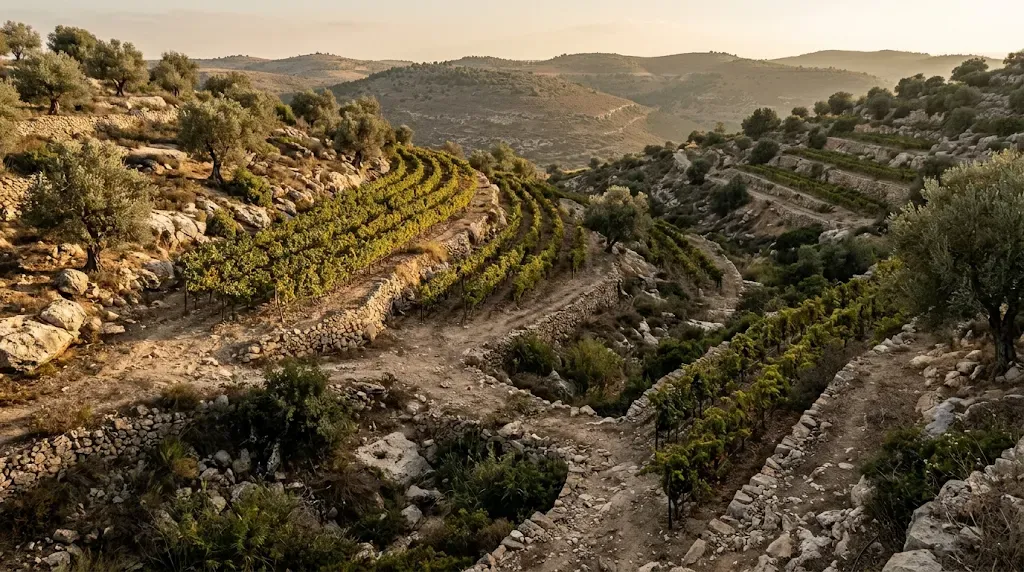
The mountainous area around Jerusalem, from north of the city to the south of Mount Hebron and the Yatir Forest. Many vineyards are planted on terraces and in narrow valleys, some of them inside nature reserves.
Jerusalem Hills
- Altitude
- From 500 meters west of Jerusalem to 1,000 meters north and south of the city
- Soil
- Shallow, rocky terra rossa over limestone
- Rainfall
- About 500 mm a year
- Climate
- Large temperature swings between day and night, which preserve acidity in the grapes
Vineyards planted since the early 1990s. Syrah and Chardonnay are considered varieties that do especially well here.
Standout varieties in the region: Syrah (Shiraz)Chardonnay
Gush Etzion and Hebron Hills
- Altitude
- A high mountainous area
- Soil
- Terra rossa over limestone
- Climate
- Cool at night
In the Hebron and Bethlehem area, the local varieties have been grown for generations: Dabouki, Marawi (Hamdani) and Jandali.
Standout varieties in the region: DaboukiMarawi (Hamdani)Jandali
Binyamin
A mountainous area north of Jerusalem, with many boutique wineries.
Yatir Forest
- Altitude
- 600–850 meters
- Rainfall
- About 275 mm a year
The southern edge of the Judean Hills, where the mountains meet the desert.
Negev
The largest region by area, and one of the smallest by vineyard acreage. Growing vines in the desert was common in antiquity, and the modern vineyards were planted mainly since the 1990s.
About 4% of vineyards
Negev Highlands
- Altitude
- Up to 900 meters, around Mitzpe Ramon and Sde Boker
- Soil
- Sandy soil and loess
- Rainfall
- 50–100 mm a year
- Climate
- Summer 15–40 degrees, cold nights and morning fog
The dryness protects the vines from disease, and growing relies entirely on drip irrigation. Chenin Blanc and Petit Verdot are considered varieties that do well here.
Standout varieties in the region: Chenin BlancPetit VerdotSyrah (Shiraz)
Sources
- Israel Wine Map: Regions (winesisrael.com), based on Adam Montefiore's wine regions map
- Israeli wine regions and the most suitable grape variety for each (The Jerusalem Post)
The figures for altitude, soil and rainfall are general ranges for each region. Every region has vineyards in varying conditions.