
Wine and Shmita: what to know about wine from a Shmita year
Updated: 26.10.2026 · By the Eretz Gefen team
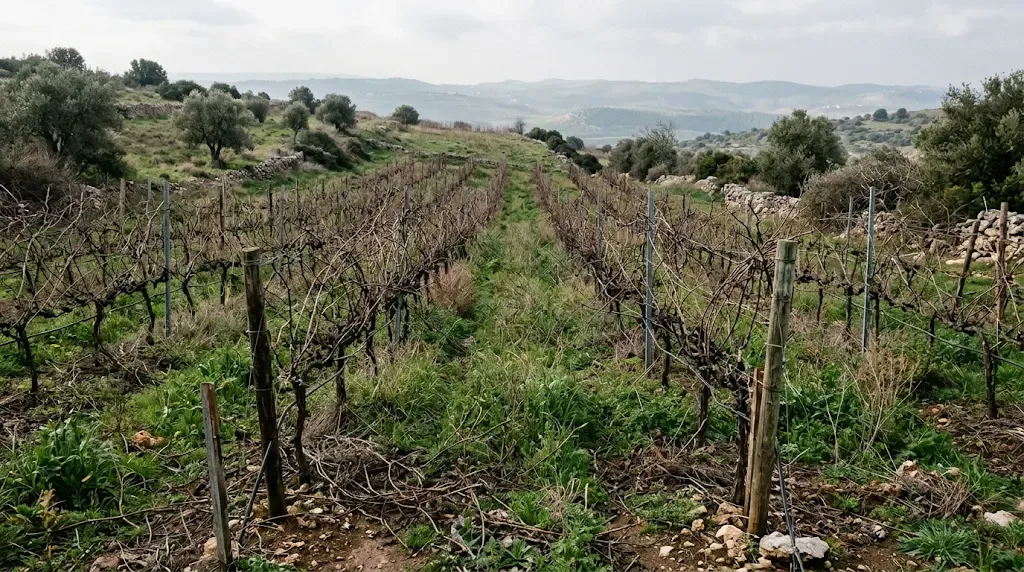
The next Shmita year, 5789, begins in September 2028. But the question is relevant today as well: Israeli wines from the 2022 vintage grew in the previous Shmita year, 5782, and many of them are still on the shelf. Here is what is worth knowing.
- The previous Shmita, 5782: from September 7, 2021 to September 25, 2022. The 2022 vintage is a Shmita vintage.
- The next Shmita, 5789: from the eve of Rosh Hashanah, September 20, 2028, until the eve of Rosh Hashanah, September 9, 2029. The 2029 vintage will be a Shmita vintage.
- On the label: look for "Otzar Beit Din", "sale permit" (heter mechira), "sanctity of the seventh year", "non-Jewish produce" or "eighth year".
This is a general summary. For any halakhic question, ask your rabbi.
Which wine counts as Shmita wine?
For tree fruits, including grapes, what determines the status is the chanatah, that is, when the fruit began to develop, and not when it was harvested. Grapes harvested in the summer of a Shmita year set fruit in the spring of that same year, so in practice the summer harvest of a Shmita year is the Shmita vintage. Kashrut authorities around the world treated the 2022 vintage as the Shmita wine of 5782.
The difference between the solutions
Sale permit (heter mechira)
The land is sold to a non-Jew for the Shmita year.
According to the permit, the produce does not carry the sanctity of the seventh year. The permit is accepted by the Chief Rabbinate, but many of the halakhic authorities, especially in the Haredi community, do not rely on it.
Otzar Beit Din
The rabbinical court is responsible for the harvest and distribution.
The court's agents harvest the grapes and distribute the produce, and the buyer pays only for the labor and expenses. The wine is sacred with the sanctity of the seventh year, and should be handled according to the laws below.
Non-Jewish produce
Grapes from vineyards owned by non-Jews.
Based on the view that land owned by a non-Jew does not acquire the sanctity of the seventh year. There is also a dispute about this solution.
Wine from another year
Sixth year or eighth year.
Some wineries produce stock from earlier vintages, and some wineries do not harvest at all in the Shmita year.
Wine with the sanctity of the seventh year at home
- Drink it, do not waste it. Do not pour it out or throw it away. The custom is to drink the wine to the end.
- Kiddush and the four cups: permitted, and some have written that it is even preferable. Some have written to avoid it for the second cup, from which drops are spilled for the plagues.
- At the Seder: do not spill drops of the wine for the ten plagues.
- At Havdalah: do not fill the cup until it overflows, and do not extinguish the candle in it.
- Cooking: avoid it, because cooking consumes the wine.
- Trade and export: one does not trade in such wine in the usual way, and does not take it out of the country.
Bi'ur (removal)
For wine and grapes of the seventh year, the time of bi'ur is the eve of Passover of the eighth year. One takes the wine out of the house, or invites three people and declares it ownerless in their presence. Afterwards one may take it back, and it still carries the sanctity of the seventh year.
- Wine from the 2022 vintage: its bi'ur time was on the eve of Passover 5783, April 5, 2023, and has already passed.
- Wine from the 2029 vintage: its bi'ur time will be on the eve of Passover 5790, April 17, 2030.
For Otzar Beit Din wine and for small quantities there are additional details of the law. Ask your rabbi.
How it works at our store
Every wine page on the site shows its kashrut certification. For wines from the 2022 vintage, it is worth checking the label or asking us before ordering. We will be happy to check for you what is written on the bottle.
More: mevushal and pasteurized wine · Mehadrin or regular
Questions and answers
When is the next Shmita year?
The year 5789, from the eve of Rosh Hashanah on September 20, 2028 until the eve of Rosh Hashanah on September 9, 2029. The 2029 vintage will be the Shmita vintage.
Is wine from the 2022 vintage Shmita wine?
The 2022 vintage grew in the Shmita year 5782. The label states which solution was used, for example the sale permit or Otzar Beit Din.
What is the difference between the sale permit and Otzar Beit Din?
Under the sale permit, the land is sold to a non-Jew, and according to the permit the produce is not sacred. Under Otzar Beit Din, the wine carries the sanctity of the seventh year and is handled according to the laws of Shevi'it.
May one make Kiddush on wine of the seventh year?
Yes. One may make Kiddush and drink the four cups on wine of the seventh year, and some have written that it is even preferable. It is not poured out and not wasted.