
How much wine do you need for an event? An accurate questionnaire, magnums, spirits and a ready-made table
Updated: 26.10.2026 · By the Eretz Gefen team
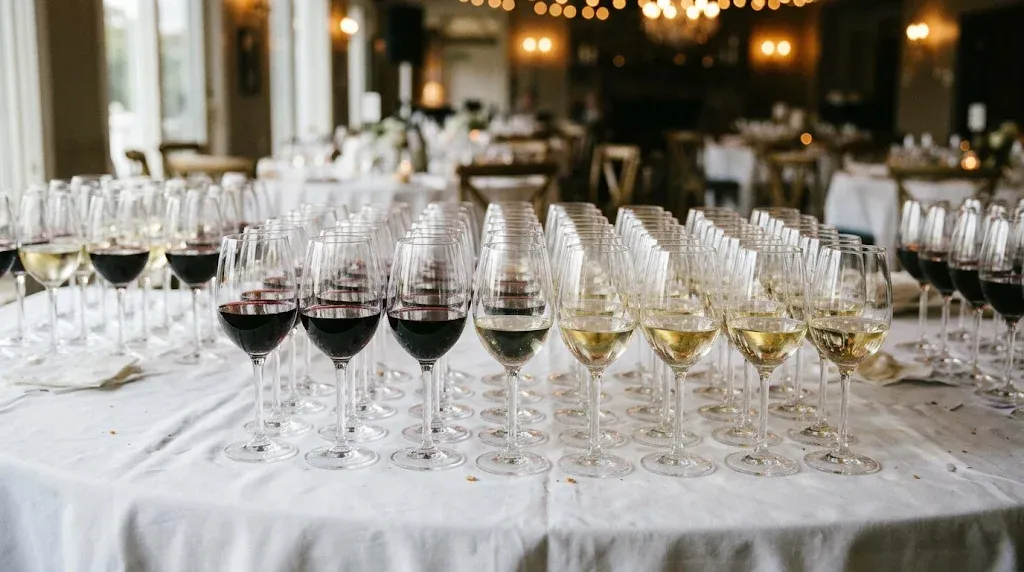
Answer a few short questions, and you will get how many bottles to order and which wines.
Questionnaire: how much wine you need for your event
The questionnaire calculates according to accepted rules of thumb in the events industry in Israel and worldwide, and according to what you tell us about the event. It takes less than a minute. At the end you will get how many bottles you need of each type, how many magnums, and roughly how much other alcohol, including a breakdown of how we calculated.
Before you order: everything worth knowing
"How much wine should I order?" is one of the first questions that arises before a wedding, bar mitzvah, brit, Shabbat Hatan or a large Shabbat meal. Order too little, and the wine runs out in the middle of the evening. Order too much, and you are left with cases. In this guide you will find a short questionnaire that calculates precisely, a ready-made table and all the considerations, so you can order exactly what you need.
- A standard bottle of wine (750 ml) holds about 5 glasses of 150 ml.
- In Israel people drink wine in moderation. At an event of 3–4 hours, an accepted rule of thumb is one bottle for every 3–4 adult guests, including those who don't drink.
- There is no need to order far beyond "just to be safe". It is better to start from a realistic number, and add only if your crowd really drinks more.
Ready-made table by number of guests
In the table: how many bottles you need for a regular event, where about 40% of the adults drink wine, and there is no other alcohol.
| Guests | 3 hours | 4 hours | 5 hours |
|---|---|---|---|
| 20 | 5 | 6 | 8 |
| 50 | 12 | 15 | 18 |
| 80 | 20 | 24 | 29 |
| 100 | 24 | 30 | 36 |
| 150 | 36 | 45 | 54 |
| 200 | 48 | 60 | 72 |
| 300 | 72 | 90 | 108 |
| 400 | 96 | 120 | 144 |
For an especially festive event, add about 10%. If there is also a bar or beer, reduce accordingly (see below).
How to calculate: the formula
To calculate it yourself, you need three figures: how many people will drink, for how long, and how many glasses each one drinks.
- How many will drink? Not all guests drink wine. Children, drivers and those who prefer another drink are not counted. At many events in Israel only a third to a half of the adults drink wine, and no more than a glass or two.
- How many glasses? A wine drinker has about a glass and a half in the first hour, and about three quarters of a glass in each additional hour. At a 4-hour event that comes to nearly four glasses per drinker.
- From glasses to bottles: divide the number of glasses by 5.
- Rounding: round up to a whole bottle, without an inflated "reserve".
100 adult guests, 4 hours, 40% drink wine:
40 drinkers × (1.5 + 3 × 0.75) = 150 glasses
150 ÷ 5 = 30 bottles, that is, 5 cartons.
Red, white, rosé or sparkling: how to split
The split depends mainly on the menu and the season:
| Situation | Red | White | Rosé / sparkling |
|---|---|---|---|
| Meat meal, winter | 65% | 25% | 10% |
| Meat meal, summer | 50% | 30% | 20% |
| Dairy or fish | 20% | 55% | 25% |
| Reception and variety | 40% | 35% | 25% |
- At events in Israel, especially in summer, chilled white and rosé go fast. Don't skimp on them.
- For a welcome reception, light, fresh wines work best: white, rosé and sparkling.
- A meat meal calls for a medium- to full-bodied red. Want to know what pairs well? See the flavor profile of each grape variety.
- For a toast: pour a small glass, about 75 ml, and usually only some of the guests take one. A bottle holds about 10 such glasses.
By type of event
Wedding
A long event, usually 4–5 hours, with a reception, a meal and dancing. Calculate the reception (light wines) and the meal separately. If the venue also serves other alcohol, you can reduce the quantity slightly.
Bar Mitzvah and Bat Mitzvah
Many young guests who don't drink. Count only the adults, and enter only them in the calculator.
Brit milah and Shalom Zachar
A short event, usually in the morning, or on Friday night for a Shalom Zachar. Wine for Kiddush and the blessing, plus a little for the meal. One bottle for every 4–6 adults is usually enough.
Kiddush at the synagogue
Served in small cups. The accepted estimate is one bottle for every 10–15 attendees, with a sweet Kiddush wine alongside for those who prefer it.
Shabbat or holiday meal with guests
For a 3-hour meal, count roughly one bottle for every two adults who drink, plus one bottle for Kiddush.
Shabbat Chatan
A Shabbat Chatan usually includes a Kiddush at the synagogue after the service, and sometimes Shabbat meals with family and guests. At the Kiddush, Kiddush wine is served and, in most cases, spirits for a "l'chaim". Count each part separately: the Kiddush by the number of worshippers (in the calculator, choose "Shabbat Chatan" and mark that spirits are also served), and the meals as a Shabbat meal.
Corporate events and conferences
Drinking is usually moderate. Choose a "relaxed" atmosphere in the calculator, and favor light, approachable wines.
When there is also a bar: how much less wine
The most common mistake is ordering wine as if it were the only drink, when in practice there is also whisky on the tables or a beer bar. Guests don't drink more because there are more kinds. They split the same amount of drinking among the beverages.
So first work out how many drink servings there will be in the evening, and only then how many of them will be wine:
| Other alcohol at the event | Wine's share of the drinking |
|---|---|
| None, only wine | 100% |
| A little (a bottle of whisky or arak on the table, for tasting) | about 85% |
| An active bar or plenty of beer | about 65% |
| A crowd that mostly drinks spirits or beer | about 45% |
How do you compare drinks? A 150 ml glass of wine contains about the same amount of alcohol as a 40 ml chaser of spirits (40%), or a 330 ml bottle of beer. So a 700 ml bottle of spirits holds about 17 servings, and a bottle of beer is one serving. The calculator uses this to estimate how much other alcohol you need as well.
Magnum and double magnum: when they're worth it
A magnum is a 1.5-liter bottle, equal to two standard bottles, and holds about 10 glasses of 150 ml. A double magnum is a 3-liter bottle, equal to four standard bottles, and holds about 20 glasses.
| Bottle | Volume | Equal to | Glasses (150 ml) |
|---|---|---|---|
| Standard | 0.75 liter | 1 bottle | 5 |
| Magnum | 1.5 liters | 2 bottles | 10 |
| Double Magnum | 3 liters | 4 bottles | 20 |
In Champagne, a 3-liter bottle is usually called a "Jeroboam", but it is the same volume.
- How to use it in practice: At events people usually bring one or two magnums, or a double magnum, in honor of the celebration. The host opens it and pours for the guests himself. It is a moment of honor and joy, and it does not replace the standard bottles on the tables.
- It looks festive. A large bottle that the host pours from is a moment guests remember, and a beautiful photo too.
- It ages more slowly. Relative to the amount of wine, a magnum has less air in the neck of the bottle. So wine in a magnum develops more slowly and keeps better over the years. It is also excellent if you want to keep a bottle from the event as a memento.
- But: not every wine is made in magnum, and the price per liter is sometimes slightly higher. It's best to order it in advance.
- A double magnum is especially impressive, but heavy (about 5 kg when full) and awkward to pour without experience. It's a good idea for someone to help the host hold it while pouring, and to keep it in a prominent place until that moment.
In the calculator you can choose a magnum or double magnum, one or two. The calculator subtracts their quantity from the red wine and works out how many additional standard bottles you need.
Tips for ordering and serving
- Do you have waiters? Order mevushal or pasteurized wine. That way, even if a waiter who doesn't observe Shabbat opens and pours, there is no problem. Everything you need to know about mevushal wine.
- Coordinate with the venue in advance. Find out whether outside wine is allowed and whether there is a corkage fee.
- Order by the case. There is often a discounted price for a case of 6, and it's easier to count and move.
- Vary, but in moderation. 2–3 wines of each type, no more. That gives guests a choice and is easy for the staff to manage.
- Chill in advance. White, rosé and sparkling are served cold, and red slightly cooler than room temperature. In summer, be sure to prepare enough ice and refrigerator space.
- Plan by the order of the evening. Light wine at the reception, red with the main course, and sparkling for the toast.
- Put a jug of water on every table. Guests will enjoy themselves more and drink in moderation.
Questions and answers
How many glasses are in a bottle of wine?
A standard 750 ml bottle holds about 5 glasses of 150 ml, or about 7 small 100 ml glasses for a toast.
How many bottles of wine do you need for 100 guests?
At a 4-hour event where about 40% of the adults drink wine, you need about 30 bottles. If the crowd drinks more, or there is no other alcohol at all, it can reach 40.
How much wine do you need for a wedding?
A common estimate is one bottle for every 3–4 adult guests, depending on the crowd and the other drinks. For an exact number for your event, use the questionnaire.
What is a double magnum?
A 3-liter bottle, equal to four regular bottles, with about 20 glasses. At events they usually bring one or two, and the host pours from it for the guests.
How do you split between red and white wine?
At a meat meal, about half to two thirds red. At a dairy meal or fish, mostly white. In summer it is worth increasing the white and rosé.
How many glasses are in a magnum?
A 1.5-liter magnum holds about 10 glasses of 150 ml, like two regular bottles.
If there is a drinks bar, how much wine should you order?
Less. If there is an active bar or plenty of beer, wine will be about two thirds of the drinking. If the crowd mostly drinks spirits, about half. The questionnaire calculates this according to what you choose.
Which wine suits an event with waiters?
Mevushal or pasteurized wine, so that even a waiter who does not observe Shabbat can open and pour it.
How much wine do you need for Kiddush at a synagogue?
In small cups, one bottle is usually enough for 10–15 participants.
You can order from us in quantities for events, including mevushal wines and spirits. Need help choosing? Write to us.
The quantities in this guide are an estimate. Actual drinking depends on the crowd, the weather and the other beverages at the event. Drink responsibly.
More guides: Mevushal and pasteurized wine · Grape varieties · Israel's wine regions