
The Hatov Vehameitiv Blessing on Wine: When to Say It, and the Sephardic and Ashkenazic Views
Updated: 18.10.2026 · By the Eretz Gefen team
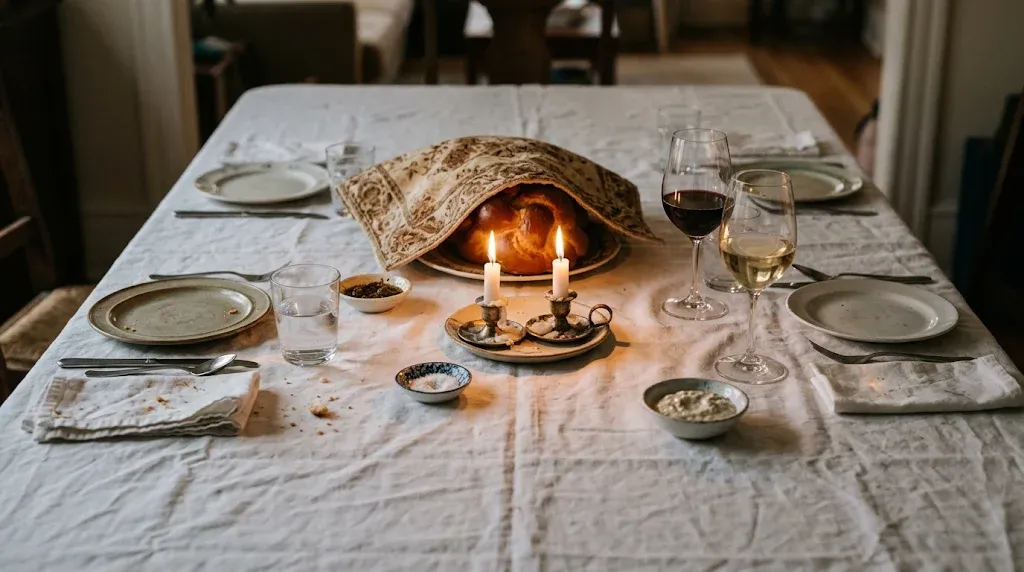
You are sitting at the Shabbat meal, you have drunk the Kiddush wine, and someone opens another bottle. Do you say "Hatov Vehameitiv"? This is one of the questions that comes up most often around the Shabbat table, and the answer depends on several conditions, with differences between Sephardic and Ashkenazic custom. Here we have gathered everything in one place, with the sources.
- Someone who is drinking wine and is then brought a different wine says over the second "Baruch Atah Hashem Eloheinu Melech Ha'olam, Hatov Vehameitiv" (and not "borei pri hagafen" again).
- The main conditions: at least two people drink, the second wine is different from the first, and it is not known to be worse than it.
- Several conditions are disputed, which is why customs differ. The table below lists each condition with the Sephardic view and the Ashkenazic view.
- The safe way: say the blessing only when all the conditions are met, even according to the stricter opinions (see "How to do it in practice").
The Source of the Blessing
The Gemara in Tractate Berachot (59b) says: "A change of wine does not require a blessing," meaning that one does not say "borei pri hagafen" again over a different wine. It continues immediately, in the name of Rabbi Yochanan: "Although they said that a change of wine does not require a blessing, one says 'Blessed is He who is good and does good.'"
The explanation: a variety of wines on the table is a sign of abundance and joy, and for this we thank God with a special blessing. This is why the blessing is said only when drinking in company. The joy of a person alone is not complete joy. The laws are detailed in the Shulchan Aruch, Orach Chayim, Siman 175.
All the Conditions: Sephardim and Ashkenazim
For each condition: what the Shulchan Aruch says, how the Sephardic authorities rule (mainly Rabbi Ovadia Yosef, in his books "Yabia Omer" and "Chazon Ovadia", and in "Halacha Berura"), and how the Ashkenazic authorities rule (mainly the Mishnah Berurah).
At least two
Shulchan AruchAnother person must drink together with you (Shulchan Aruch 175:4). Your wife and children count.
SephardimSo rules Rabbi Ovadia Yosef: at least two, both of whom drink from the first wine and then from the second.
AshkenazimThe Mishnah Berurah says the same. It adds that those drinking must be partners in the wine (Magen Avraham and Mishnah Berurah). It is therefore preferable for the host to give guests permission to drink as they wish.
The second wine is different from the first
Shulchan AruchOne says the blessing over a different wine. In Siman 175 (se'if 6) it is explained that even wine of the same vintage that was divided into two barrels within forty days of the harvest is considered two kinds.
SephardimAccording to Rabbi Ovadia: from a different variety (such as Merlot and Cabernet Sauvignon), or an old and a new wine, or from different wineries or vineyards whose taste differs.
AshkenazimA wine that tastes different, for example because of a different winery, production process or vintage. It does not have to be a better wine.
The second wine is not worse
Shulchan AruchOne says the blessing as long as the second is not known to be worse than the first (Shulchan Aruch 175:2, following Tosafot and the Rosh).
SephardimRabbi Ovadia rules like the Shulchan Aruch: better, or at least not known to be worse. The Kaf HaChaim is stricter and says the blessing only over a wine that is clearly superior, and so does Rabbi Mordechai Eliyahu.
AshkenazimThe Mishnah Berurah rules like the Shulchan Aruch. Some are stricter and say it only over a clearly superior wine (Arukh HaShulchan, Minchat Yitzchak). According to Rabbi Elyashiv, what counts is the accepted taste, not personal taste.
Some of the first wine remains
Shulchan AruchThe authorities disagree on whether some of the first wine must remain. The view of Maran, the Shulchan Aruch, is that it need not.
SephardimRabbi Ovadia: since there is a dispute, and "when in doubt about blessings, rule leniently" (i.e., do not say them), one says the blessing only if a little of the first wine remains. If the first bottle is finished, even if there are more bottles like it in the pantry, one does not say it.
AshkenazimThe Mishnah Berurah: if the first wine is finished and a different wine is brought, one does not say the blessing.
The second wine was not on the table
Shulchan AruchAccording to the Shulchan Aruch one says the blessing even when both wines were in front of him from the start. The Levush is stricter: a wine that was on the table when the "Hagafen" blessing was said is covered by it.
SephardimRabbi Ovadia: strictly speaking one says the blessing, but it is right to be stringent that the second wine not be on the table when the blessing is said over the first.
AshkenazimThe Mishnah Berurah contains contradictory statements on this (175:4 versus 175:5 and 14). In practice it is recommended to bring the second wine only after the "Hagafen" blessing.
During a meal
Shulchan AruchThere is a dispute over whether a bread meal is required. Rashi requires a meal, and the Rambam does not.
SephardimRabbi Ovadia: only during a meal with bread. The Meknes custom, cited by Rabbi Shalom Messas, is to say the blessing even at a meal without bread, for example at a fruit meal on Tu BiShvat.
AshkenazimMany authorities do not require a bread meal. Some are stricter (the Kaf HaChaim cites early authorities who require one).
How much to drink
Shulchan AruchThe Shulchan Aruch did not set a measure.
SephardimRabbi Ovadia, following Rabbi Yosef Yedid Halevi: there is no measure, and even a taste is enough. Kaf HaChaim: a revi'it from each of the wines. Rabbi Ben Zion Abba Shaul: at least a mouthful of the second wine.
AshkenazimMost authorities do not set a measure, and some are strict about a revi'it.
Still intending to drink
Shulchan AruchIf they diverted their attention from drinking, and say "borei pri hagafen" again, they do not say "Hatov Vehameitiv".
SephardimRabbi Ovadia: if they have already decided to stop drinking, for example after Birkat Hamazon, one does not say the blessing over the second wine.
AshkenazimThe Mishnah Berurah: over a cup of Birkat Hamazon of a different wine one does not say "Hatov Vehameitiv", because Birkat Hamazon includes this blessing.
Grape juice
Shulchan AruchWhether grape juice is treated like wine for the purposes of the blessing is disputed among the later authorities.
SephardimAccording to "Halacha Berura" (Rabbi David Yosef), even if the first was grape juice, one says the blessing over a second wine. Some Sephardic authorities (as cited in the Moroccan custom) hold that the first must be wine.
AshkenazimMany write that if Kiddush was made over grape juice and wine was drunk afterward, the blessing is not said, since some do not consider grape juice to be wine. Grape juice after wine is considered "worse," and the blessing is not said over it.
How to Do It in Practice at the Shabbat Table
To say "Hatov Vehameitiv" without doubt according to most opinions, take care to do all of the following:
- Make Kiddush or say "Hagafen" over the first wine, and those at the table drink from it. At least two, for example the husband and wife.
- Do not place the second wine on the table when the blessing is said over the first. Leave it in the kitchen, and bring it afterward.
- Choose a different second wine, not worse than the first: a different variety, a different winery or a different vintage.
- Make sure some wine remains in the first bottle. Do not finish it before opening the second.
- Say the blessing during the meal, after washing hands and "Hamotzi".
- Say "Hatov Vehameitiv" and drink, at least two of those at the table. The husband fulfills the obligation for his household, or each person says it for himself (see below).
According to the rulings of Rabbi Ovadia Yosef: wherever there is doubt, for example when the first wine has run out, or outside a bread meal, one does not say the blessing, because "when in doubt about blessings, rule leniently."
According to the Mishnah Berurah: it is right to avoid situations of doubt in the first place. For example, if it is clear that one of the wines is better, place both on the table and say "Hagafen" over the better one, and then you do not say "Hatov Vehametiv".
Additional Laws
- Who says the blessing? According to the Shulchan Aruch (175:5), when eating, each person says it for himself, since there is a concern about the danger of answering amen while eating. When only drinking, one person says it and fulfills the obligation for everyone. Rabbi Mordechai Eliyahu wrote that each person says it for himself.
- A third and fourth wine: one says "Hatov Vehameitiv" over these too, when the conditions are met.
- Forgot to say it: according to the Mishnah Berurah (175:15), if he remembers while there is still wine to drink from the second bottle, he may say it.
- The Seder night: the Mishnah Berurah recommends refraining from drinking a different wine at the Seder meal, so as not to enter into this question.
- Kiddush wine as the first wine: the Kiddush wine counts as the first wine. According to Rabbi Ovadia there is no minimum amount to drink, so even someone who tasted only a little of the Kiddush wine says the blessing afterward over a second wine.
Which Second Wine to Choose
According to most authorities, the second wine must be different from the first, and not worse than it. In practice:
- A different grape: for example, Kiddush over Merlot, followed by Cabernet Sauvignon or Syrah. Grape variety guide
- A different winery or vintage: according to Rabbi Ovadia, even a wine of the same grape from a different winery or a different year counts as different.
- Not inferior: according to the stricter opinions, the second wine must be clearly better. To satisfy every view, it is best for the second wine to be of a higher level.
- A sweet Kiddush wine followed by a dry wine: these are clearly different. If there is doubt whether the second is inferior, ask a rabbi.
Questions and answers
What is the text of the Hatov Vehameitiv blessing?
Baruch Atah Hashem Eloheinu Melech Ha'olam, Hatov Vehameitiv. (Blessed are You, Lord our God, King of the Universe, who is good and does good.)
Does one say Hatov Vehameitiv when drinking alone?
No. Another person must drink together with you from both wines. Your wife or children count.
Does the second wine have to be better?
According to the Shulchan Aruch it is enough that it is not known to be worse, and so rule Rabbi Ovadia and the Mishnah Berurah. Some are stricter (Kaf HaChaim, Arukh HaShulchan) and say the blessing only on a clearly superior wine.
What if the first wine runs out?
According to Rabbi Ovadia Yosef and the Mishnah Berurah, if the first wine runs out before the second is brought, one does not say Hatov Vehameitiv.
Does one say Hatov Vehameitiv outside a meal?
Rabbi Ovadia rules that it is said only during a meal with bread. Many authorities, including the Meknes custom cited by Rabbi Shalom Messas, are lenient and say it even without a bread meal.
Kiddush was made over grape juice, and then wine was drunk. Is the blessing said?
There is a dispute about this. According to "Halacha Berura" the blessing is said. Some authorities say it is not, since some do not consider grape juice to be wine for this purpose.
Is Hatov Vehameitiv said over a cup of Birkat Hamazon?
No. According to the Mishnah Berurah, Birkat Hamazon itself already includes the blessing of Hatov Vehameitiv.
This guide is meant to lay out the opinions in an orderly way and is not a halachic ruling. For practical halachic questions, especially in cases of doubt, consult a rabbi.
Sources
- Babylonian Talmud, Berakhot 59b; Shulchan Aruch, Orach Chayim, section 175, and its commentators (Magen Avraham, Mishnah Berurah, Kaf HaChayim)
- Conditions for the Hatov Vehametiv blessing, according to the rulings of Rabbi Ovadia Yosef (Halacha Yomit), and there: Responsa Yabia Omer vol. 9, section 108; Chazon Ovadia; Halacha Berurah vol. 9, section 175
- When is Hatov Vehametiv recited? (Hidabroot)
- The quantity to drink for Hatov Vehametiv (Rabbi Eli Mansour, Daily Halacha)
- When is Hatov Vehametiv Recited? (Magen Avot, Moroccan customs)
- The Hatov Vehametiv blessing on wine (Wikiyeshiva)
- The Blessing of Hatov V'Hameitiv over Wine (Weekly Halacha, Torah.org)
- Mishnah Berurah section 175, subsections 3–6, summary (Mishna Berura Yomi)
More guides: Wine for Shabbat and holiday dishes · Mevushal and pasteurized wine · Grape varieties